A wasp nest in a loft or roof is almost always treated from the outside, at the small gap the wasps are using to get in — under a tile, behind a soffit, at the sloping edge of a gable. Nobody goes into the loft, nothing is drilled, lifted or cut, and it is one visit at £60 fixed across Manchester and Greater Manchester. The nest itself stays where it is. It dries out over the following weeks and is never used again.
Most national advice pages tell you a nest in the roof is dangerous and stop there. This is the rest of it: how to be sure the nest is really up there, the five places wasps get in on the housing stock round here, and what is left behind afterwards.
First, be sure it is actually in the roof
Wasps in the garden mean nothing on their own — workers forage hundreds of metres from home. What tells you there is a colony in the building is a commute. Stand well back, on the far side of the garden or across the road, pick the one point on the roofline you suspect, and watch that single point for two or three minutes without moving your eyes around.
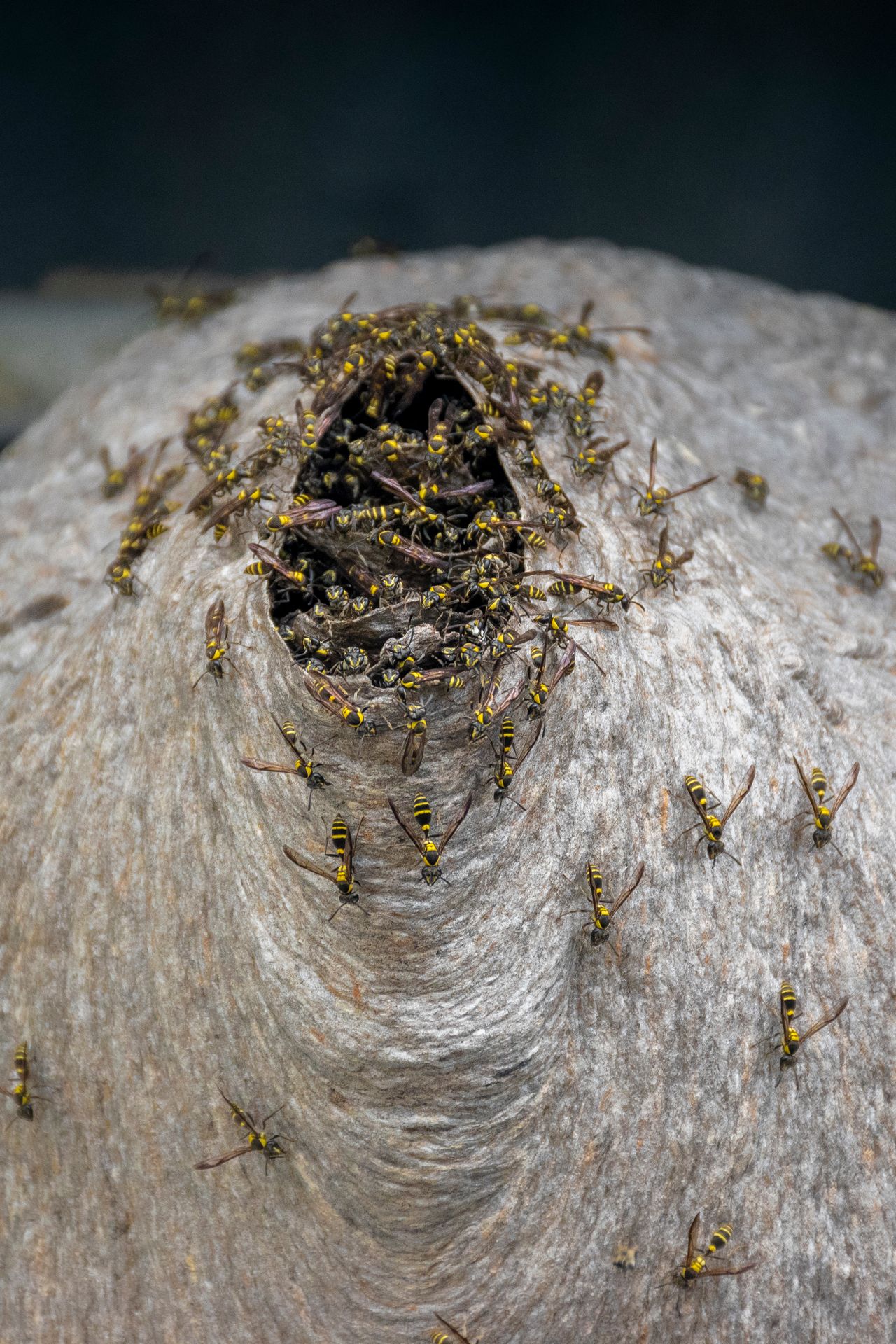
- A nest looks like traffic. Wasps converge on one spot from several directions, drop straight into a gap no bigger than a 2p coin, and leave again on straight purposeful lines. It is two-way and it is steady.
- Foraging looks like wandering. A wasp working the fascia for wood pulp or hunting flies moves along the boards, doubles back, and drifts off. No fixed destination.
- Watch the arrivals, not the departures. Departing wasps scatter and are hard to follow. Returning wasps funnel in, which makes the entry point obvious.
- Pick the right conditions. Mid-morning to late afternoon, dry, warm, no strong wind. On a cold or wet day a busy nest can look almost dead.
- Wasps indoors are not proof of location. A handful of dead wasps on a landing windowsill tells you a nest is in the fabric of the building somewhere. It does not tell you which side.
The five ways wasps get into a roof around Manchester
The stock here is mostly Victorian and Edwardian terraces, interwar and 1930s semis, and post-war estates — and the entry points repeat. In rough order of how often we find them:
- The gap under the bottom course of tiles. On a pitched roof the lowest course of tiles overhangs the fascia, and there is a finger-width space between tile, batten and felt where the roof turns out into the gutter. Where the felt has perished at the eaves, or a tile has slipped a few millimetres, that space runs straight into the roof void. This is the single most common entry we see, and it is invisible from the ground unless you are watching for the flight line.
- The bay-roof junction on a 1930s semi. The little tiled or leaded roof over a front bay meets the main wall at a mortar fillet or a lead flashing. Fillets crack and drop out in sections after fifty or sixty winters. Wasps use the crack, nest in the bay void, and sometimes carry on into the main roof space above.
- Boxed timber soffits on interwar semis. Deep boxed eaves in painted timber are everywhere on the interwar streets in Stretford, Urmston and Burnage. Once the paint has broken down and a board has shrunk, there is a continuous slot along the joint between soffit and fascia, or at the mitre on a corner. Behind it is a dry, sheltered, undisturbed box — close to an ideal nest site.
- The verge at a gable end. The mortar bedding along the sloping edge of a gable weathers hard, cracks, and loses chunks. A missing hand's width of verge mortar is a wide-open door, and because it sits at the top of a wall with nothing below it, people rarely look there.
- The ridge on a Victorian villa. The tall roofs in Whalley Range and Victoria Park have ridge tiles bedded in lime mortar that has been softening for a century. Wasps go in at the very top of the roof. These nests are the easiest to spot from the pavement and the hardest to reach — see the section on height below.
Timber soffits, UPVC soffits, and why capping changes nothing
Bare or painted timber soffits are the obvious candidate: they shrink, they split along the grain, and the gaps are visible if you stand under them and look up.
The one that catches people out is UPVC. Most plastic eaves on older houses are an overclad job — new boards capped over the original timber rather than the timber being stripped out first. That leaves the void behind the boards fully intact, and the plastic trim almost always leaves a hairline gap at the end returns, at a corner mitre, or where it butts up to a downpipe bracket. So a house with clean white plastic eaves and a nest in them is completely normal, and it does not mean the capping was done badly. It just means the box behind is still there and a queen found the way in back in May.
Does anyone need to go into the loft?
Usually not. The treatment is applied as an insecticidal dust at the entry point outside. Wasps walking in and out pass through it, carry it into the nest on their bodies and legs, and spread it through the colony including to the queen. That is why the entry point matters far more than the nest does, and why standing in your loft would achieve nothing except a worse view and a longer walk.
Nothing is drilled. No tiles are lifted, no soffit board is unscrewed, no plasterboard is cut and no insulation is pulled back. The job happens at a gap that already exists.
The exception is a nest hanging in the open inside the loft with no workable route from outside — occasionally the case where wasps are getting in through a gable vent or an integral garage. Then it is treated from the loft hatch, at the hatch, not by crawling across the joists.
What gets left behind is the nest. Removing it means opening up the roof, which is expensive and pointless: wasp nests are single-use and no colony will ever move back into it. It goes dry and brittle and eventually crumbles. A large nest in a warm loft can smell faintly for a week or two while the larvae die back, and that passes on its own.
How many wasps are actually up there
More than it looks like from the ground, and fewer than it sounds like from the bedroom. Buglife, the UK invertebrate conservation charity, puts a mature common wasp nest at 5,000 to 10,000 individuals. A nest reaches that scale in late August and September, at the very end of the colony's life. The same nest in early July might hold a few hundred, and in May it was a golf-ball starter nest with one queen in it.
Why a boarded or insulated loft sounds far worse than it is
A plasterboard ceiling behaves like a drum skin. Loft boards resonate, and joists carry sound sideways for several metres. The result is that a nest well over on the other side of the roof void, near the eaves, can sound as though it is directly above the bed. Mineral wool insulation muffles some of the higher notes but the low continuous rustle carries through it easily.
So volume is not a measure of size, and it is not a measure of how close the colony is to breaking into the room. Wasps have no reason to chew into your bedroom — they already have a front door, and it goes outside. The one thing that changes that is blocking it.
Do not seal the gap yet
Sealing the entry point is worth doing eventually. That gap is what attracted the queen in the first place, and an unsealed gap can attract a different queen next spring. But sealing it too early is the classic mistake, and it is how wasps end up inside the house: cut off from the way out, a colony will chew inwards through plasterboard, around downlighters, and past a loft hatch.
The honest timeline after treatment, rather than the reassuring one:
- First hour or two. Activity often looks worse, not better. Disturbed wasps mill around the entry point. This is normal and is not a sign the treatment has failed.
- Within 24 hours. A sharp drop. Most of the colony is gone.
- Two to four days. Stragglers. Foragers that were out at the time of treatment keep coming back to a dead nest, and each of them picks up the dust on the way in.
- Up to a week or so in peak season. With a big August nest, the occasional wasp at the entrance for several more days is normal.
The rule of thumb: watch the entry point for two or three minutes on two separate warm days and see nothing at all, then seal it. In practice that is seven to ten days in August, and often sooner in June. If you are having the eaves or the verge repointed anyway, that is the sensible time to close it up properly.
Gutter height, third storeys, and where we stop
Being straight about the limits is more useful than pretending there are none. Ladder work from firm, level ground covers eaves, gutter and soffit height on a standard two-storey house, and that accounts for most of the roofline on the terraces and semis across Manchester and Greater Manchester — including the bay junctions and the boxed soffits above.
Where it stops:
- Third-storey ridges. A ridge nest on a tall Victorian villa is genuinely out of ladder reach. That needs a tower or scaffold, which is a different trade with a different bill.
- Nothing to stand on. A nest above a conservatory, a lean-to or a flat garage roof where a ladder cannot be footed safely on solid ground.
- No safe footing at all. Steeply sloping gardens, soft ground after heavy rain, or a gap too narrow to set a ladder at a sane angle.
- Access we do not have. A nest reachable only from a neighbour's side or a shared ginnel, without their say-so.
If you can describe where the nest is on the phone, we will tell you then. If it only becomes clear on the doorstep, we will tell you there and you pay nothing. Ten honest minutes on the phone beats a wasted afternoon for both of us.
When you do not need to call anyone
- An old nest found in the loft in winter or spring. Grey, papery, hollow, silent. It is dead and it will not be reused. Bag it and bin it yourself, or leave it — it does no harm either way.
- A nest in a detached garage or shed roof in October. If nobody goes near it, the colony collapses on its own within weeks. Treating it changes very little.
- One or two wasps at a window in late autumn. These are new queens looking for somewhere to hibernate, not a colony. Let them out of a window.
- Bumblebees in the soffit or loft. Big, furry, slow, a deep buzz, and only a few dozen coming and going rather than a constant stream. A bumblebee colony dies back naturally by late summer and the site is not reused, so the right answer is almost always to leave it alone until then. Our bumblebee page covers the rare cases where that is not workable.
- Honeybees. Thousands of small ginger-brown bees, or a hanging cluster the shape of a rugby ball. These are not something we treat — a local beekeeper may collect a honeybee swarm. Our identification guide takes about thirty seconds to run through.
Wasps going into your roof?
£60 fixed fee, same-day across Manchester and Greater Manchester. You do not need to have found the entry point — describe where you see them and we will find it from the ladder. Call 07770 015197.
Call to BookFrequently Asked Questions
No, not in most cases. The nest may sit in the roof void, but the treatment goes in at the point outside where the wasps are entering — under a tile, behind a soffit, at a gable verge. The wasps carry it in themselves. A loft visit is only needed when the nest hangs in the open with no usable route from outside.
Wasp nest treatment in a loft or roof costs £60, fixed, across Manchester and Greater Manchester. Height, awkward access and the size of the colony do not change the price. There is no separate call-out charge, and if the nest is still active afterwards we come back and re-treat at no cost.
No, and there is rarely a good reason to. Getting a nest out of a roof void means lifting tiles, cutting boards or pulling back insulation, which costs far more than the treatment and risks the roof. A treated nest is inert. It dries out, goes brittle, and is never reused by another colony.
No. Nothing is drilled, lifted, cut or unscrewed for a normal roof treatment. The whole job happens at a gap that is already there, from a ladder outside. If a nest genuinely cannot be reached without opening something up, we tell you that instead of doing it.
Activity at the entry point usually spikes for the first hour, drops sharply within 24 hours, and tails off over the following two to four days. In August, with a large colony, expect the odd stray wasp for a week or so as foragers that were out at the time return to a dead nest.
Often not, and we will say so before you commit. Ladder work covers eaves and gutter height on a standard two-storey house, which is most of the housing stock here. A third-storey ridge, or a nest above a conservatory where a ladder cannot be footed safely, needs tower or scaffold access — a different trade.
Almost always in the roof void directly above that ceiling, with an entry point you have not spotted yet. Sound carries a long way along joists and plasterboard, so a nest three or four metres away can sound like it is right overhead. Walk outside, stand well back, and watch the whole roofline rather than the spot you can hear.